

2025 Water Fellows Program: Cultivating the Next Generation of Water Resources Leaders

The 2025 Water Fellows cohort completed an intensive summer program, with five undergraduate students engaging in rigorous research projects, collaborative learning, and professional development. The cohort included Emma Busteed, Dario Cano, Auldyn Faulk, Rachel Haley, and Lily Stitt.
The students’ efforts culminated in poster presentations at the annual Agriculture, Forests, and Water Conference in July, where each Fellow addressed challenges ranging from protecting water quality in farming areas to using smartphone technology to monitor changes in stream structure.
The program provided hands-on research experience while offering opportunities to explore specific interests in water resources management. Each Fellow was paired with experienced faculty mentors who guided them through the scientific research process and helped navigate their academic and professional aspirations. Among these diverse research initiatives, one project exemplified how emerging technology can address longstanding challenges in environmental monitoring.
Innovative Technology in Stream Monitoring
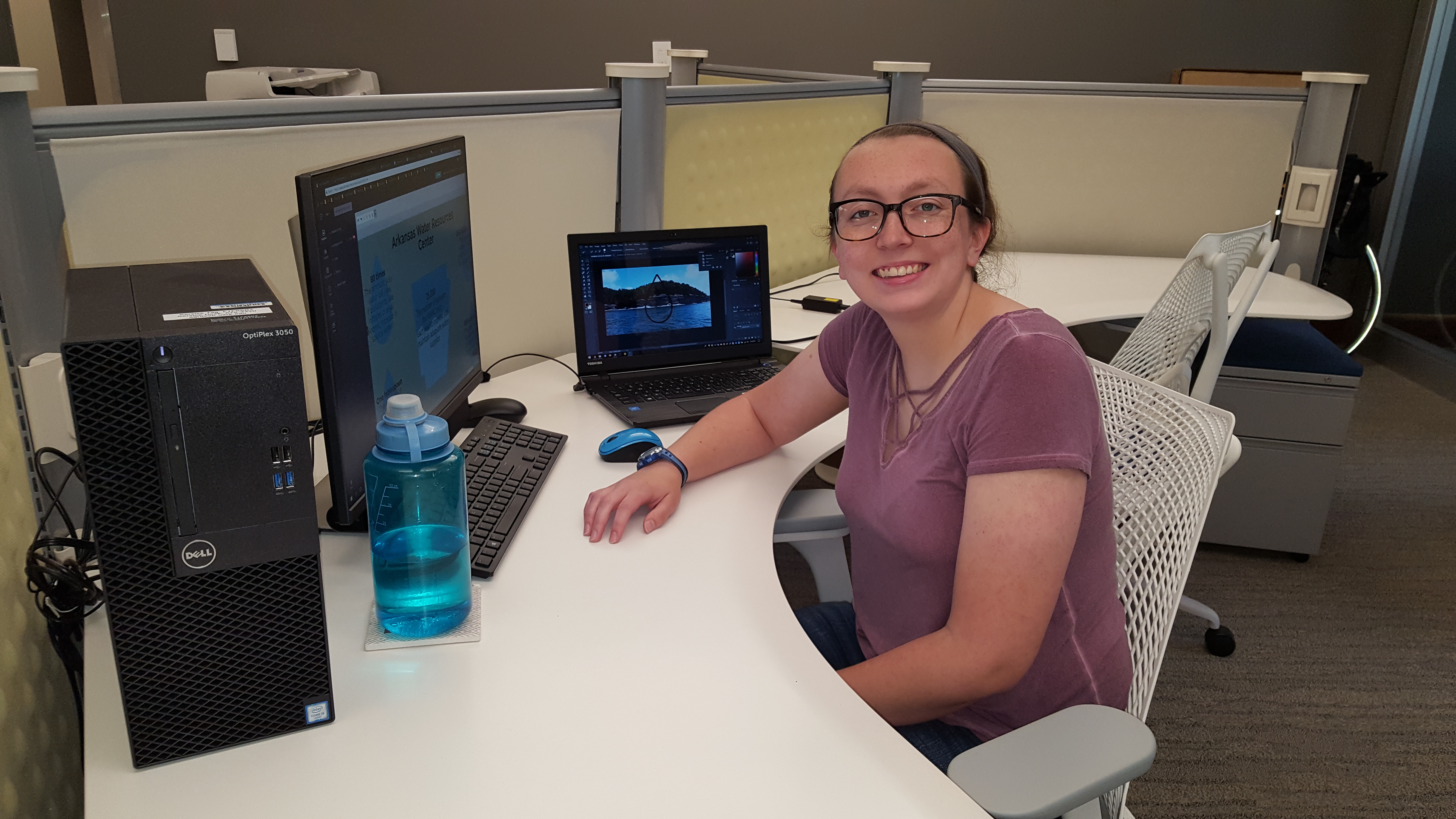
Stitt, a University of Arkansas honors student in biological engineering and a 2025 Water Fellow, spent her summer exploring new technology for stream monitoring and working under the mentorship of Joshua Blackstock, a Research Soil Scientist at the USDA Agricultural Research Service and Research Affiliate with the Center for Advanced Spatial Technologies at the University of Arkansas. Stitt investigated using an iPhone’s LiDAR scanner technology as an alternative method for measuring and monitoring streambank morphology in Northwest Arkansas.
“Frequent monitoring of streams is essential to assess the effects human activity has on them, especially in regions undergoing rapid land use change, such as Northwest Arkansas,” explained Stitt.
This technology offers a cost-effective and time-efficient solution that could transform field data collection practices. During her summer fieldwork, Stitt performed several highly accurate scans per day, a frequency rarely achievable with traditional methods like terrestrial LiDAR. The technology provides opportunities for more frequent data collection while making stream monitoring accessible to a broader range of users.
Building a Foundation for Future Research
For Stitt, the Water Fellows program also served as a jump start on working on her honors thesis. “This program allowed me to get a significant head start on my honors thesis. Having three months dedicated solely to developing my background knowledge, conducting fieldwork, and processing my findings was an incredibly valuable experience,” Stitt said. “The Water Fellows program not only helped me clarify the direction of my thesis, but also gave me the time and space to deeply engage in my topic.”
The experience extended beyond technical skills. Presenting her research at the conference proved equally rewarding, building her confidence in communicating complex scientific concepts. “This experience grew my confidence in communicating my research clearly to a broad audience and allowed me to meet people who were interested in the work I developed,” she said.
As Stitt prepares for graduate school, she credits the program with providing essential preparation for a research career. “The Water Fellows program gave me the invaluable opportunity to learn from my project mentor’s expertise in fieldwork, data analysis, and research communication,” Stitt said. “As I prepare to pursue graduate school next year, I am confident this experience has equipped me with the foundation needed for a successful career in research!”
A Partnership Advancing Research and Education
Blackstock praised both Stitt’s performance and the program itself. “The Water Fellows program provides future biological engineers like Ms. Stitt an authentic research experience and one that we hope she can reflect on and learn from as she moves forward in her career,” he said. “Ms. Stitt represented the Department of Biological and Agricultural Engineering well as a Water Fellow, demonstrating her high acumen for problem solving, applying engineering and hydrology first principles, and public speaking. Ms. Stitt certainly has a bright future ahead of her!”
For Blackstock, mentoring through the Water Fellows program has been mutually beneficial. “Participating as a mentor with the Water Fellows program has been a fantastic experience!” he said. “The Water Fellows program has been beneficial for our research mission at the Dale Bumpers Small Farms Research Center and a great opportunity to showcase the research we carry out at the USDA’s Agricultural Research Service in support of farmers and U.S. agriculture.”
The success of projects like Stitt’s demonstrates the effectiveness of the Water Fellows program in fostering innovation and preparing the next generation of water resources professionals to address complex environmental challenges with creative solutions.